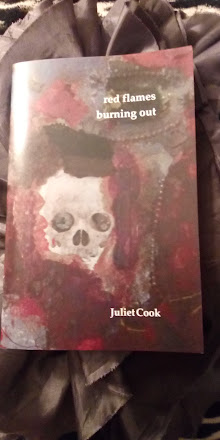
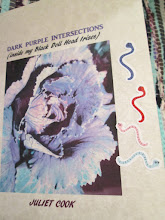
I have a new poem up at Everyday Genius today. The content on this page changes rapidly (like every day?), so read this hideous little ditty while it's hot--
http://www.publishinggenius.com/everydaygenius.htmlYou can also partake of editor Adam Robinson's nifty blog about the piece on the Publishing Genius blog--
http://publishinggenius.blogspot.com/*
update: A day later and my poem is now in the archives:
http://www.publishinggenius.com/eg-juliet-cook.htmI thought of a few comments I want to make stemming from the above-referenced blog, but have some other stuff to tend to first, so more on that soon...
*
Okay, I'm back.
I've been rather plagued by one kind or another of insomnia lately, so I'm sometimes just lying there in bed with various thoughts coursing through my head, most of them random, unproductive, or even counterproductive, but at least some of them are semi-productive or creative. So at some point last night, I was thinking a little about Adam Robinson's aforementioned blog entry. Here is an excerpt:
'I just let myself associate with it and from that association comes the, what, the grist (if you will), and then I allowed that grizzle (um) to be enough in terms of "understanding," and to be part of the thing that is the poem. I guess I'm arguing for an "Against Interpretation"-type reading here, as always. And why not? Otherwise, I'd be reminded of David Orr's condescending article in the Times -- " . . . the trendiest contemporary style, which relies heavily on disconnected phrases, abrupt syntactical shifts, attention-begging titles (“The Gem Is on Page Sixty-Four”), quirky diction (“orangery,” “aigrettes”), flickering italics, oddball openings (“The scent of pig is faint tonight”) and a tone ranging from daffy to plangent — basically, two scoops of John Ashbery and a sprinkling of Gertrude Stein . . ." (link) --And I'd think, yeah, but come on Tackleberry: it's good. Orr lists these characteristics like they're a detriment, as if to say they're cataloged, so clearly Juliet Cook didn't think of this first -- so what can the value be? A checklist of tropes employed does not strike me as a productive way to read Cook's poem, or any poem. 'It's a bit interestingly odd to me for one of my poems to be mentioned in the context of trendiness, but that's not what I wanted to talk about, just a small aside.What I wanted to talk about, albeit briefly, is that the quote from the condescending Times article, especially the part about 'attention-begging titles' made me remember the first psychologist I ever saw, well over a decade ago, for several sessions of supposed talk-therapy. In one of our first sessions, this psychologist questioned me about my choice of attire.
I don't remember exactly what I was wearing, except that part of my attire was a Siouxsie & the Banshees t-shirt--baggy and black with a huge white print of Siouxsie's face across the front, perhaps looking like some kind of abstract ghost. Although I do not recall the other details of my attire that day, I know that I enjoyed a rather flamboyant style of dress when I was in my early 20s, so I can imagine I might have been decked out in what appeared a bit outlandish or excessive to my middle-aged, conservative-seeming psychologist. Still, this struck me as a strange and somewhat trivial matter for him to question me about.
Why was I wearing whatever I was wearing? Mainly because I liked it. It was in the vein of whatever style I enjoyed at that time. It was the style that made me feel in my element and appealing and maybe even artsy. Sometimes I used my appearance (the aspects that I could control anyway, such as my clothes) as another kind of self-expression; maybe this seemed to me like an extension of my artistic expression.
Although using my personal style as some kind of artistic canvas is not a very important mode of self- expression for me these days, I still think his query was kind of silly. I mean who really cares how somebody dresses when there are so many more more important things to question, analyze, explore, and discuss?
I do understand what he was getting at. He perceived my attire as 'attention-begging' and so was using that as an entrypoint for starting a conversation about why I felt the need for attention, why I felt the need to make myself stand out in that way, and so forth. That may well have been a valid conversation, but what if I was just wearing what I was wearing because I liked it, because it made me feel good, because it was a style that worked for me?
Maybe based on his sense of style, my style seemed overly flamboyant or excessive, but so what? Maybe based on my sense of style, his style seemed boring, uncreative, and uninspired. Couldn't anyone negatively or positively interpret someone else's sense of style based on their own personal preferences and largely subjective filters? Couldn't any style be assessed semi-generically or (mis)interpreted or questioned based on certain personal presuppositions? What did he think I SHOULD have been wearing? A plain white t-shirt and blue jeans that weren't too loose and weren't too tight? I was an early twentysomething female creative writing student, not Bruce Springsteen.
Maybe he thought I should have been wearing something that blended in more, that didn't stand out--but couldn't a person's seeming need or desire to fit in be questioned just as validly as someone else's need or desire to stand out? Or to look at it from a different vantage point, where's the big difference between someone wearing a college sweatshirt or sports team jersey in order to fit in with a certain group versus someone else wearing more quirky or artistic attire in order to fit in with a different kind of group? Or maybe most of these people are just wearing whatever it is they personally enjoy wearing. Isn't it largely just a matter of personal style, subjective self-expression, and then others' varied interpretations of such?
Segueing this into the realm of 'attention-begging' poem titles, I find myself wondering, 'Okay, what kind of titles would HE prefer then--and WHY?' To each his own preferences and opinions, of course, but personally, I don't think of attention-getting as a bad thing. Since he said attention-BEGGING instead of attention-getting, that implies to me he seems to think such titles are desperate or trying too hard or overly clever or maybe even lacking in authenticity.
Poetry sometimes involves a certain degree of artifice, but for me personally, a certain kind of truth, verisimilitude, authenticity is also very important. But of course MY truth is not going to be everyone's truth. But just because MY truth doesn't ring true for you, that doesn't mean it's fake or contrived or gimmicky or just for show. I won't tell anyone else how to interpret one of my poems, because their experience of a poem is bound to be based upon factors beyond my control that are tied to their own perspective, perceptions, and filters. However, if asked, I could most certainly elaborate on what a particular poem means to me--and in very specific detail.
I LIKE attention-getting titles. I like weird, seemingly abstract yet strangely apt, semi-conceptual, delightfully offbeat titles. I also have plenty of poems that have fairly straightforward one word titles because sometimes that's what seems apt. I guess it just depends on the poem. Even with the more oddball titles though, it's not like I just pulled them out of a hat. I can't control how others' see them, but I don't see them as random or nonsensical. I don't like nonsene, but I also don't like overly obvious. I like oblique precision or precise obliquity. I like poems that function based on their own peculiar logic.
Robinson mentions 'negative reviews' in his entry; that is, reviews based on what a reader DOESN'T like. I'm not sure I think those kind of reviews are very valid. I mean they're valid enough in terms of an individual expressing his personal opinion or interpretation or experience, but they don't seem valid in terms of literary criticim to be taken seriously. I mean I may very well be interested in reading about how a certain individual interprets, experiences, and otherwise responds to my poems, but I'm not going to take such a response very seriously if it primarily consists of a subjective list of what he doesn't like with no particular explanation of WHY.
I have no problem with individual interpretation (indeed, I am quite interested in individual interpretation), but individual interpretation is not analagous with professional assessment.
This blog entry is not meant to be any kind of serious treatise either. Just a few off the cuff thoughts.